How many sheets of plywood do you need?
October 31, 2026 · 6 min read
The quick answer is to add up the area of your parts and divide by the area of a sheet. It is also how people end up one sheet short on a Saturday afternoon. In one example below, it says one sheet and the real answer is four.
Why area alone fails
Area tells you the minimum material, not whether the parts fit. Sheets are cut in straight lines, so what matters is how the parts stack. Three things use up a sheet without showing up in the area:
- Long parts leave a stub at the end of the sheet that may be too short for anything else.
- Grain takes away the option of turning a part to make it fit.
- Kerf and edge trim shrink the sheet and take material between parts.
Five projects measured
We ran five projects through the optimizer with a 1/8"3 mm kerf and 1/2"10 mm of edge trim on 4×8 ft (96 × 48")2500 × 1250 mm sheets. The bars show part area, where a block is one full sheet.
| Project | Part area | Area ÷ 0.8 | Real sheets | |
|---|---|---|---|---|
| Bookcase, 72 × 36", carcass | 0.95 | 2 | 2 | |
| Toy chest | 0.73 | 1 | 1 | |
| Two nightstands, carcass | 0.68 | 1 | 1 | |
| Eight drawer boxes, sides | 0.68 | 1 | 1 | |
| Four 48 × 24" shelf decks | 1.00 | 2 | 4 |
| Project | Part area | Area ÷ 0.8 | Real sheets | |
|---|---|---|---|---|
| Bookcase, 1830 × 915 mm, carcass | 0.91 | 2 | 2 | |
| Toy chest | 0.70 | 1 | 1 | |
| Two nightstands, carcass | 0.65 | 1 | 1 | |
| Eight drawer boxes, sides | 0.63 | 1 | 1 | |
| Four 1250 × 625 mm shelf decks | 1.00 | 2 | 4 |
A common shortcut is to allow 20% for waste by dividing the area by 0.8. It gets four of these five right, so it works as a first budget. It misses the last one by a factor of two, and it cannot warn you when that is about to happen.
The quarter-sheet trap
Four 48 × 24"1250 × 625 mm panels are exactly one 96 × 48"2500 × 1250 mm sheet on paper. In the shop they need 4 sheets with edge trim, because a 48"1250 mm panel no longer fits across the sheet, and two of them no longer fit along it.
Skipping the trim does not rescue it. With no trim at all the kerf still gets in the way, and the job takes 2 sheets.
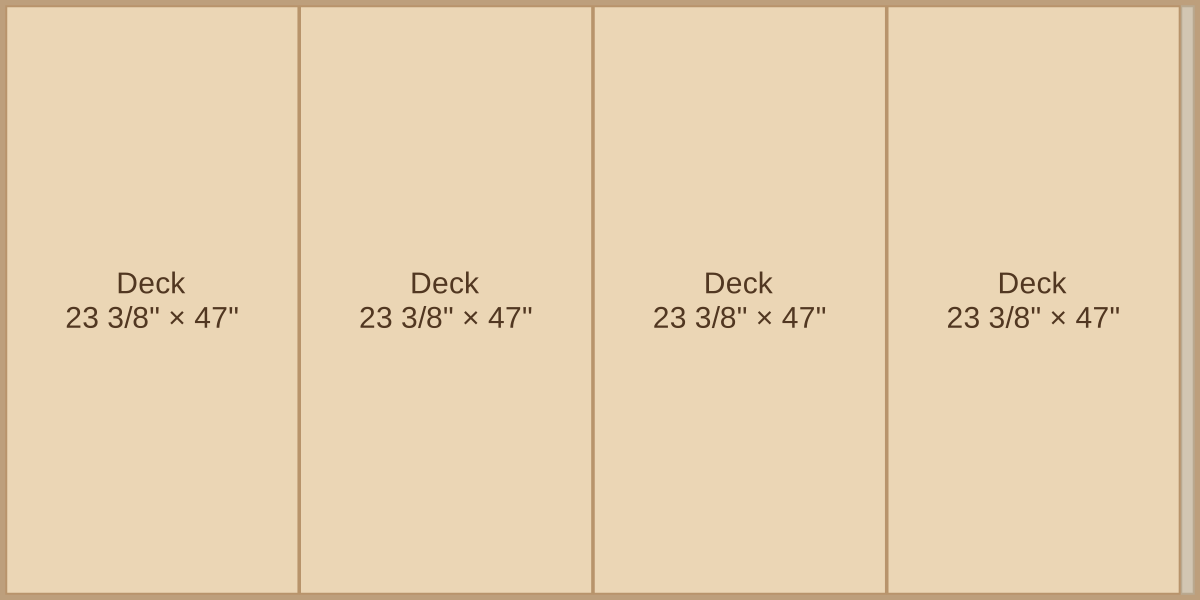
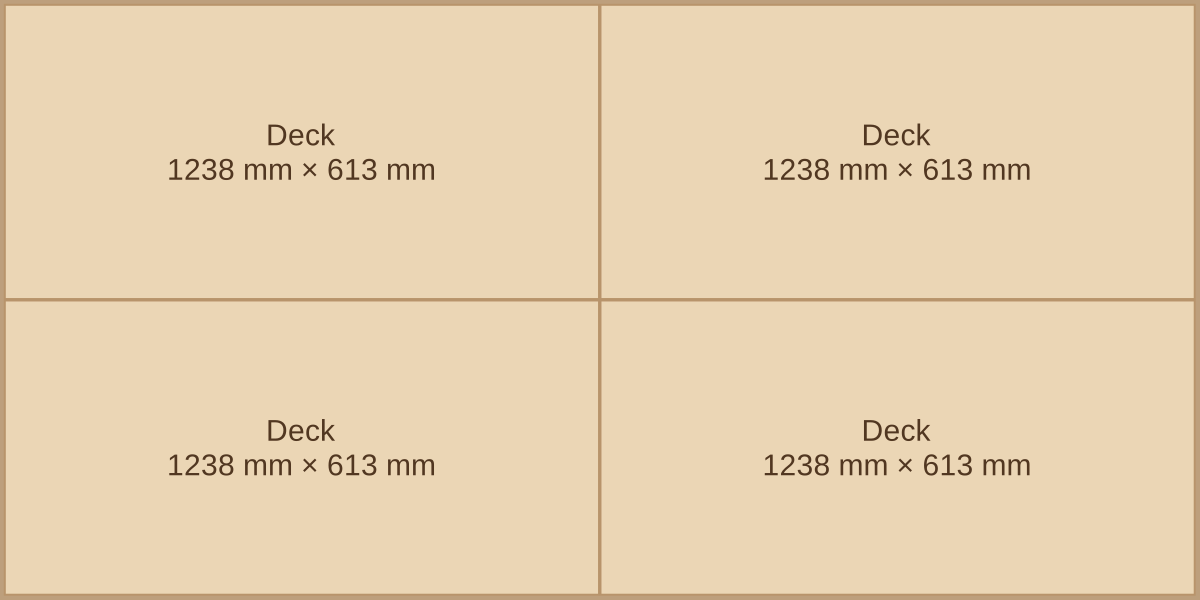
The fix is in the design. If those panels can be 47 × 23 3/8"1238 × 613 mm, all four come out of 1 sheet with 53% waste. That small reduction saved three sheets. Whenever a part size looks like an even fraction of a sheet, check whether it can come down slightly.
A method that works
- Separate by material and thickness. Each gets its own count.
- Check every part against the usable sheet: nominal size minus trim on both edges. A part that does not fit needs a bigger sheet or a joint.
- Budget with area ÷ 0.8, rounded up. That is your floor for a price estimate, not your order.
- Lay it out with grain and kerf included. The free calculator does this in the browser and shows the sheet count as you type.
- Check near-misses. If a small trim to one part would drop a whole sheet, it is usually worth changing the part.
Covering a floor, wall or roof
This guide is about cutting parts from sheets. When you are covering a surface instead, area is the right tool: divide the surface by the area of one sheet, add about 15% for offcuts and mistakes, and round up.
128 sq ft ÷ 32 sq ft = 4.0, × 1.15 = 4.6, so 5 sheets12.5 m² ÷ 3.125 m² = 4.0, × 1.15 = 4.6, so 5 sheets
Openings, seams that must land on supports and staggered layouts can change that number, and structural sheathing has to follow your local building rules.
Before you buy
- Check the real sheet size. Not every panel is 96 × 48" exactly.2500 × 1250 mm is common, but other formats exist. Measure one or ask the supplier.
- Think about a spare. On a project with expensive face veneer or a tight delivery, one extra sheet costs less than a second trip for a miscut. Sheets from a later batch may not match in color either.
- Plan the transport. Many yards will make rough cuts to fit your car. Have them cut along a line on your layout with room to spare, then trim to final size at home.
Every layout and sheet count in this guide was calculated by the optimizer inside Plyplan.